
Our offices will be closed for the holiday season from December 25, 2025, to January 11, 2026. For urgent matters, please contact support@pecb.com.
Artificial intelligence (AI) governance in the European Union (EU) encompasses the principles, processes, and controls that ensure AI systems are safe, ethical, and aligned with European values and fundamental rights. Developing and implementing AI governance enables organizations to promote safety, fairness, transparency, and accountability.
Within the EU, AI governance is primarily shaped by the EU Artificial Intelligence Act (EU AI Act), the first comprehensive legal framework specifically designed to regulate AI. The EU AI Act establishes a risk-based approach that classifies AI systems according to their level of risk and sets corresponding obligations for providers, deployers, and other stakeholders across the AI value chain.
AI governance in the European context is also influenced by other applicable regulations, including the EU Data Act, the General Data Protection Regulation (GDPR), and other digital regulations that influence how organizations collect, manage, share, protect, and use data in AI-enabled environments.
Effective AI governance enables organizations to balance innovation with responsible AI adoption by ensuring that AI technologies deliver value while minimizing potential legal, ethical, operational, and societal risks.
The continued development and widespread adoption of AI technologies have created significant opportunities for innovation, efficiency, and economic growth. However, AI systems may also introduce risks related to safety, privacy, security, transparency, fairness, accountability, and the protection of fundamental rights. Effective AI governance provides organizations with the necessary structures and practices to identify, assess, and manage these risks while promoting the responsible use of AI.
Within the EU, AI governance plays a critical role in ensuring that AI systems are developed and used in a manner that aligns with European values and legal requirements. Through regulations such as the EU AI Act, organizations are required to adopt a risk-based approach, establish appropriate governance mechanisms, and implement measures to ensure the reliability, transparency, and accountability of AI systems.
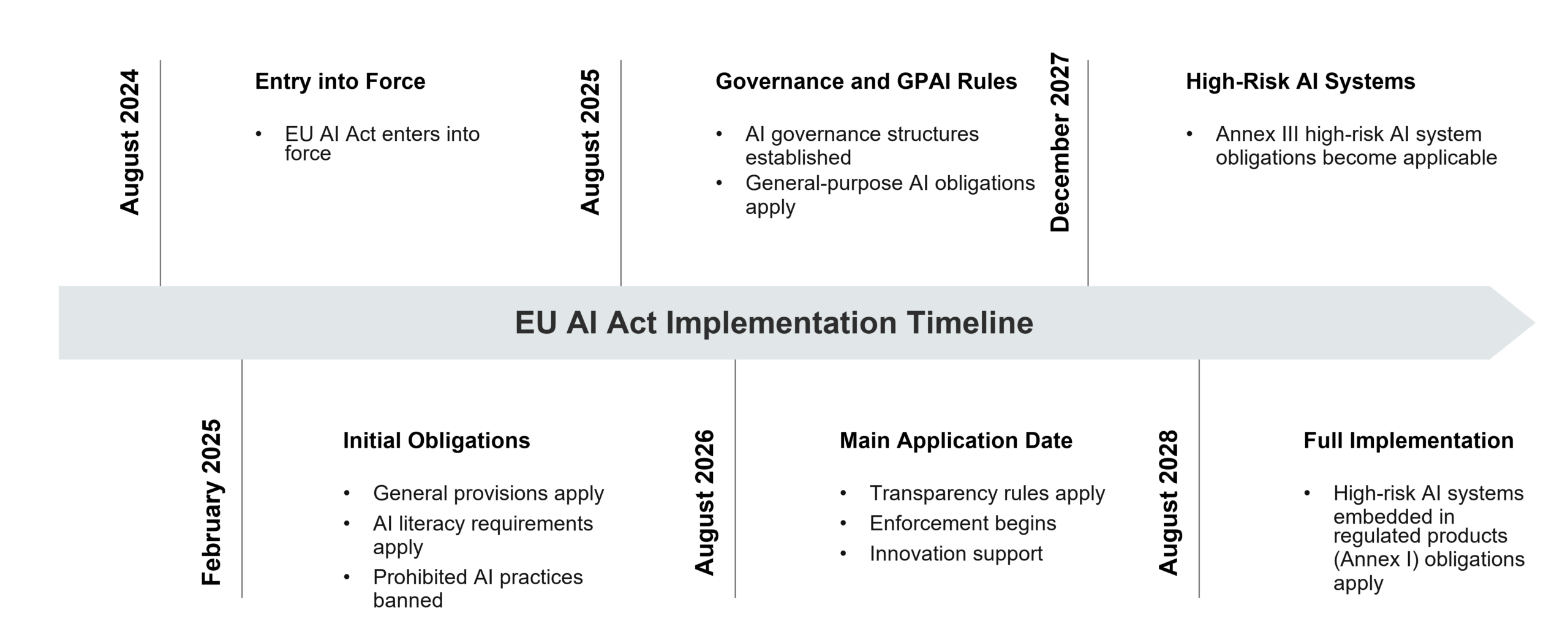
The EU AI Act rolls out in stages through August 2027. It began with general provisions and prohibited practices from February 2025, followed by rules for general-purpose AI models and required governance structures (national authorities, penalties, EU-level bodies) from August 2025. The majority of rules of the AI Act come into force and enforcement starts on August 2026, covering high-risk AI systems under Annex III, transparency requirements, innovation-support measures, and mandatory national regulatory sandboxes, alongside enforcement at national and EU level. Finally, rules for high-risk AI embedded in regulated products apply from August 2027.
As a result, AI governance in practice is not static but continuously evolving. Organizations must progressively strengthen their controls, mechanisms of monitoring, and compliance processes. This dynamic approach ensures that AI systems remain compliant, trustworthy, and aligned with EU regulatory expectations throughout their life cycle.

The Certified EU AI Governance Professional credential provides:
The Certified EU AI Governance Professional training program is designed to develop comprehensive knowledge of AI governance. Experienced trainers guide participants through key concepts, practical scenarios, and real-world applications, enabling them to apply their knowledge effectively within their organizations.
The program provides a strong understanding of the EU AI Act and its requirements, along with practical guidance on implementing AI governance frameworks.
Contact us to begin with the first step.
Download and personalize our request letter to ask your employer for funding.