What Is Quality Management?
Quality management is the coordinated approach an organization uses to establish quality objectives and policies and direct, control, and improve the activities that affect the quality of its products and services. It covers quality planning, quality assurance, quality control, and quality improvement.
By understanding customer needs, defining requirements, managing processes, and evaluating results, organizations can prevent or reduce quality-related issues and improve performance.
Quality management extends across the organization, from product and service design to purchasing, delivery, and customer support.
How Does Quality Management Support Business Performance?
Quality management helps organizations deliver products and services that consistently meet customer needs and applicable requirements. Clear responsibilities, controlled processes, and performance monitoring help prevent errors, reduce rework, and improve the use of resources. Analyzing customer feedback and addressing the causes of nonconformities also enables organizations to make informed improvements and maintain consistent performance as their operations evolve.
The business importance of quality extends to customer retention. PwC’s 2025 U.S. Customer Experience Survey, which included 5,511 consumers and 406 executives, found that 52% of consumers had stopped using or buying from a brand following a bad experience with its products or services, while 29% had done so because of a poor customer experience online or in person. Among executives, 70% reported that customer expectations were changing faster than their organizations could adapt. This finding highlights how failures in product and service delivery can affect customer relationships.
The figure below further illustrates a significant gap between executive perceptions and consumer experiences. Although 89% of executives believed that customers had become more loyal to their companies in recent years, only 39% of consumers reported becoming more loyal to the brands they frequently used, representing a 50-percentage-point difference. Meanwhile, 52% of consumers reported no change in loyalty and 7% reported becoming less loyal. These findings indicate that organizations may perceive customer loyalty differently from how customers themselves experience it. Such a gap highlights the importance of using customer feedback, complaints, performance data, and other evidence rather than relying primarily on internal perceptions. A systematic approach to quality management can support this by helping organizations identify problems and consistently improve products, services, and customer interactions.

Customers experience quality through reliable products, clear communication, timely delivery, and effective responses when something goes wrong. Achieving that consistency requires coordination across functions and external providers. ISO 9001 helps organizations determine and meet customer and applicable statutory and regulatory requirements, assign responsibilities, establish operational controls, and use performance information to guide improvement.
Its practical value extends across the product and service life cycle. Organizations can clarify requirements before committing to customers, assess development results before release, and determine controls for externally provided work. When outputs do not conform, a structured response helps contain the issue and address causes so that problems are less likely to recur.
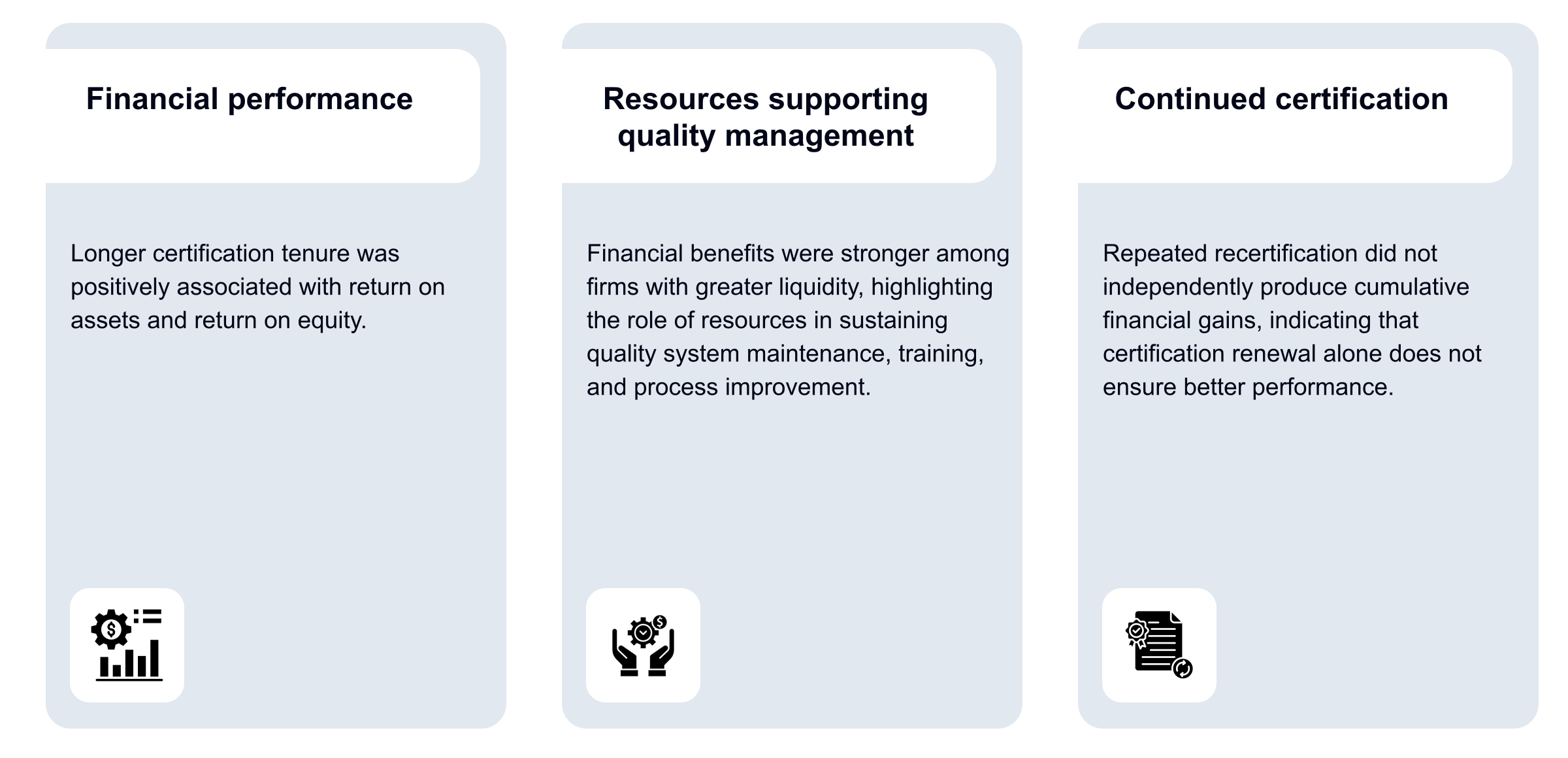
ISO reports more than one million ISO 9001 certificates across 189 countries. This reach illustrates the standard’s widespread use as a common reference for quality management. Research highlights the relationship between sustained ISO 9001 certification and business performance. A 2026 study of Moroccan-listed companies examined 19 continuously certified firms over 2015–2024, using 88 firm-year observations and a matched sample of noncertified firms. Longer certification tenure was associated with modest improvements in financial performance, with stronger benefits among companies with greater liquidity. The findings emphasize the importance of having sufficient financial resources to sustain investment in quality management.