Artificial intelligence has moved beyond experimental; it is now operational.
Organizations are implementing AI systems on a scale, which creates two distinct professional responsibilities:
- Professionals who build AI systems
- Leaders who govern and scale AI initiatives
The Certified Artificial Intelligence Professional (CAIP) and Certified Artificial Intelligence Manager (CAIM) certifications are designed for these separate functions. They complement one another, but they are not interchangeable. The choice between CAIP and CAIM comes down to a simple question: Are you developing AI systems or leading AI programs? CAIP focuses on building AI, while CAIM focuses on governing it.
Both certifications are crucial in today’s organizations, yet each fulfills a fundamentally different purpose.
This article explains the difference clearly so you can choose the certification that matches your role.
Certified Artificial Intelligence Professional (CAIP)
CAIP is designed for professionals who design, develop, and implement AI solutions.
The certification covers a broad range of AI domains, from foundational concepts to advanced applications, with a strong emphasis on hands-on implementation and responsible AI practices.
CAIP Focus
- Machine learning (supervised, unsupervised, reinforcement learning)
- Deep learning (including neural networks and CNNs)
- Natural language processing (NLP)
- Computer vision
- Robotics and expert systems
- Data analysis and visualization
- Ethical AI, risk management, and compliance at the technical level
Educational Approach
- Hands-on labs in a virtual environment
- Practical exercises based on real-world scenarios
- Application of AI tools, models, and frameworks
- Certification-aligned quizzes and exercises
Who Should Choose CAIP
- AI practitioners and engineers
- Data scientists and machine learning specialists
- Developers working with AI-enabled systems
- IT managers overseeing technical AI projects
- Risk and compliance professionals working closely with AI systems
- Executives and decision-makers who need a deep technical understanding of AI
What CAIP Prepares You For
- Designing and implementing AI solutions
- Building, training, and optimizing AI models
- Applying advanced AI techniques in real-world environments
- Addressing AI risks, bias, privacy, and compliance from a technical perspective
- Supporting AI initiatives with both technical and strategic understanding
If your role requires you to build and implement AI solutions, CAIP is the appropriate certification.
Certified Artificial Intelligence Manager (CAIM)
CAIM is designed for professionals who manage, govern, and scale AI initiatives across an organization.
An AI manager does not build models. The role is to ensure AI initiatives deliver measurable value, align with business strategy, and operate within clear governance and risk frameworks.
CAIM Focus
- AI strategy and roadmap development
- Use case identification and prioritization
- Governance, fairness, transparency, and compliance
- KPI definition, dashboards, and performance tracking
- Automation and AI agents using low/no-code tools
- Stakeholder communication and change management
Who Should Choose CAIM
- Managers and team leads
- Digital transformation leaders
- AI program and project owners
- Risk, compliance, and governance professionals
- Business leaders responsible for AI outcomes and ROI
What CAIM Prepares You For
- Managing AI initiatives at an organizational level
- Translating AI capabilities into business value
- Overseeing AI projects without programming
- Ensuring responsible and compliant AI adoption
- Tracking results using Power BI dashboards and AI agents (e.g., n8n)
If your responsibility is to lead and oversee AI initiatives, CAIM is the appropriate certification.
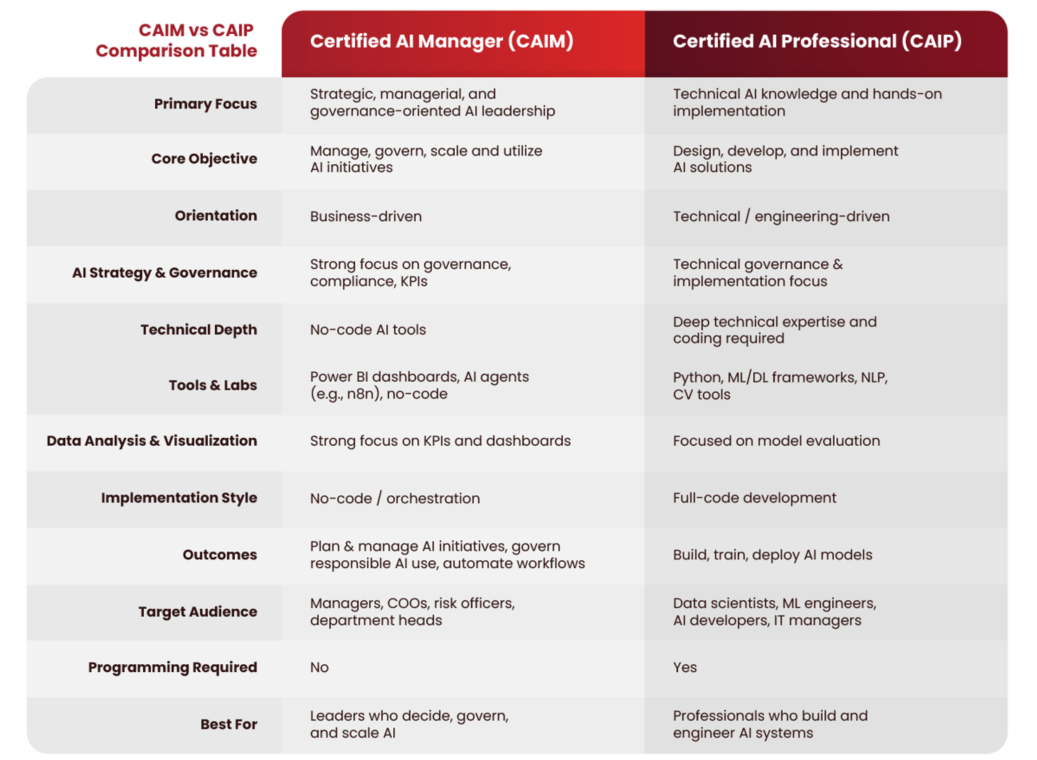
CAIM vs. CAIP — Quick Comparison
Which Certification Should You Choose
Artificial intelligence initiatives usually fail for two main reasons: either the technology is built incorrectly, or the initiative is poorly governed.
Strong technical execution without strategic guidance leads to disconnected, one-off projects. Strong strategy without technical capability results in slow or failed transformation.
This is why most organizations need both roles: one to implement AI and one to manage it responsibly.
- Choose CAIP if your responsibility is to design, build, and deploy AI systems.
Learn More
- Choose CAIM if your responsibility is to lead, govern, justify, or scale AI initiatives.
Learn More