Nos bureaux seront fermés pour la période des fêtes du 25 décembre 2025 au 11 janvier 2026. Pour toute urgence, veuillez contacter support@pecb.com.

Nos bureaux seront fermés pour la période des fêtes du 25 décembre 2025 au 11 janvier 2026. Pour toute urgence, veuillez contacter support@pecb.com.

Nos bureaux seront fermés pour la période des fêtes du 25 décembre 2025 au 11 janvier 2026. Pour toute urgence, veuillez contacter support@pecb.com.

Formation EBIOS

Qu’est-ce que EBIOS ?

EBIOS (Expression des Besoins et Identification des Objectifs de Sécurité) est un outil d’appréciation des risques développé par le Service Central de la Sécurité des Systèmes d’Information (SCSSI) pour apprécier et traiter les risques au sein d’un système d’information. Bien qu’il puisse s’appliquer à différents domaines, EBIOS est principalement utilisé pour gérer les risques liés à la sécurité de l’information, les risques liés à la protection de la vie privée, les infrastructures critiques et l’ergonomie des outils de travail. En tant qu’approche de management du risque, EBIOS permet d’identifier, d’analyser, d’apprécier et de traiter les risques dans le cadre d’une démarche d’amélioration continue.

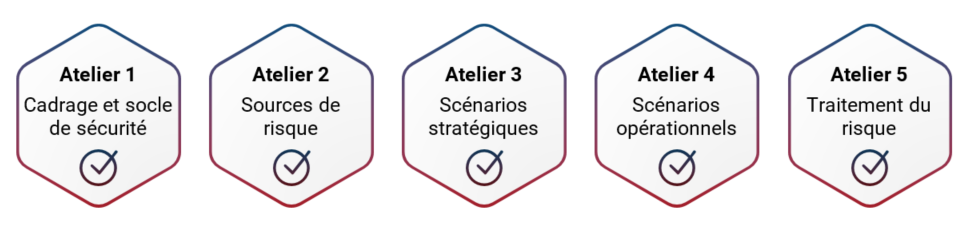
L’approche EBIOS adopte un cycle itératif qui s’articule autour de cinq phases, également appelées ateliers : cadrage et socle de sécurité, sources de risque, scénarios stratégiques, scénarios opérationnels et traitement du risque.
Que peut vous apporter la méthode EBIOS ?

Les approches basées sur les risques offrent une méthode efficace pour assurer la sécurité des systèmes d’information. Appliquer la méthode EBIOS peut donc réduire de manière significative les risques informatiques au sein d’une organisation. Elle peut être utilisée pour élaborer une étude complète du système d’information de l’organisation, adaptée à son contexte.

Les formations EBIOS de PECB fournissent un ensemble complet de guides dédiés au management des risques liés au système d’information. Elles vous permettent d’acquérir une approche cohérente et de haut niveau du traitement des risques. En obtenant la certification PECB Certified EBIOS Risk Manager, vous serez à même de démontrer vos connaissances pratiques et vos capacités professionnelles à soutenir une organisation dans la réalisation et le suivi de ses analyses de risques.

Avantages de la certification PECB EBIOS Risk Manager

La certification PECB EBIOS Risk Manager apportera la preuve de votre maîtrise des aspects suivants :

  • Compréhension des concepts et principes de base du management du risque associé à l’utilisation de la méthode EBIOS
  • Acquisition des compétences requises pour réaliser une appréciation des risques s’appuyant sur la technique EBIOS
  • Maîtrise des compétences requises pour gérer les risques de sécurité des systèmes d’information d’une organisation
  • Approfondissement des compétences requises pour analyser et communiquer les résultats d’une approche EBIOS

Comment puis-je démarrer la formation EBIOS Risk Manager ?

Les experts de PECB sont à votre disposition pour vous aider dans le processus de certification et dans l’obtention du titre de compétence PECB Certified EBIOS Risk Manager.

Contactez-nous pour faire le premier pas

Pourquoi choisir PECB pour la certification EBIOS Risk Manager ?

Les certifications PECB dans le domaine de la sécurité de l’information sont reconnues sur le plan international et accréditées par les principales autorités compétentes. Compte tenu de la réputation et de la reconnaissance dont jouit PECB, la certification PECB EBIOS Risk Manager offrira aux professionnels des opportunités de carrière fructueuses dans l’un des secteurs les plus porteurs et bénéficiant de la croissance la plus rapide et la plus demandée sur le marché international.

Formations PECB Certified EBIOS Risk Manager disponibles

Découvrez-en davantage sur EBIOS en suivant les formations EBIOS de PECB. Vous trouverez ci-après la formation qui conviendra le mieux à vos besoins.

Need support for your career development?

Download and personalize our request letter to ask your employer for funding.

Explore Issue

Related Course

ISO/IEC 27001 Information Security Management System – Training Courses


Learn how to build your expertise in ISO/IEC 27001, the international standard for Information Security Management Systems (ISMS). Whether you’re starting your journey or advancing your career, our ISO/IEC 27001 training courses and certifications equip you with practical, in-demand skills to protect data, manage information risks, and enhance digital trust.

What is ISO/IEC 27001?

ISO/IEC 27001 provides requirements for organizations seeking to establish, implement, maintain and continually improve an information security management system. This framework serves as a guideline towards continually reviewing the safety of your information, which will exemplify reliability and add value to services of your organization.

Why is ISO/IEC 27001 important?

ISO/IEC 27001 assists you to understand the practical approaches that are involved in the implementation of an Information Security Management System that preserves the confidentiality, integrity, and availability of information by applying a risk management process. Therefore, implementation of an information security management system that complies with all requirements of ISO/IEC 27001 enables your organizations to assess and treat information security risks that they face.

Certified ISO/IEC 27001 individuals will prove that they possess the necessary expertise to support organizations implement information security policies and procedures tailored to the organization’s needs and promote continual improvement of the management system and organizations operations.

Moreover, you will be able to demonstrate that you have the necessary skills to support the process of integrating the information security management system into the organization’s processes and ensure that the intended outcomes are achieved.


ISO/IEC 27001 Requirements and Controls?

Key Requirements of ISO/IEC 27001

ISO/IEC 27001 outlines several mandatory requirements that ensure a systematic approach to managing sensistive information. The most important rrequirements include:

  1. Context of the Organization
    • Identify internal and external issues affecting information security.
    • Determine the needs and expectations of stakeholders.
  2. Leadership and Commitment
    • Top management must demonstrate active involvement in ISMS implementation.
    • Establish clear roles, responsibilities, and policies.
  3. Risk Assessment and Risk Treatment
    • Identify, analyze, and evaluate risks to information security.
    • Implement appropriate risk treatments to mitigate identified risks.
  4. Support
    • Provide adequate resources, training, and communication to ensure ISMS effectiveness.
  5. Operation
    • Plan, implement, and control ISMS processes.
    • Manage risks and security incidents effectively.
  6. Performance Evaluation
    • Conduct internal audits and management reviews to evaluate ISMS performance.
  7. Continual Improvement

ISO/IEC 27001 Annex A Controls

ISO/IEC 27001 was updated in 2022 to ensure that information security management systems based on it effectively address the ever-evolving security challenges. The revision mainly focused on Annex A, where its controls were restructured into four themes, and the number was reduced from 114 to 93 controls.

The four themes of the security controls of ISO/IEC 27001:2022 are:

  1. Organizational Controls
    • Information Security Policies: Develop and implement comprehensive security policies.
    • Incident Management: Have processes in place for reporting and responding to security incidents.
  2. People Controls
    • Awareness and Training: Ensure employees understand security risks and practices
    • Screening: Conduct background checks during recruitment.
  3. Physical Controls
    • Secure Areas: Protect physical access to information processing facilities.
    • Equipment Security: Prevent loss or damage to assets.
  4. Technological Controls
    • Access Control: Restrict system access based on roles and responsibilities.
    • Cryptography: Use encryption to protect sensitive data.

27001 controls

The main changes between ISO/IEC 27001:2013 and ISO/IEC 27001:2022

The transition from ISO/IEC 27001:2013 to ISO/IEC 27001:2022 introduces significant updates to align with evolving cybersecurity and privacy needs. The standard title has expanded from focusing solely on « information security management systems » to incorporating « information security, cybersecurity, and privacy protection » in the 2022 version. Technical revisions include replacing terms such as « international standard » with « document » and « may » with « can, » reflecting a more flexible and modern approach. 

Additionally, Annex A has been streamlined, reducing the controls from 114 across 14 categories in the 2013 version to 93 controls organized into four key themes: organizational, people, physical, and technological. These changes make the 2022 standard more concise and practical for today’s information security challenges.
 

iso 27001:2013 vs 27001:2022

Understanding ISO/IEC 27001:2022 Annex A Controls

Key steps in ISO 27001 certification process

Explore the ISO/IEC 27001:2022 Annex A controls and how to implement them, to strengthen your ISMS and safeguard against cyber threats.

Benefits of ISO/IEC 27001 Certification

Obtaining the PECB ISO/IEC 27001 Certificate will prove that you have:

  • Obtained the necessary expertise to support an organization to implement an Information Security Management System that complies with ISO/IEC 27001
  • Understood the Information Security Management System implementation process
  • Provide continual prevention and assessments of threats within your organization
  • Higher chances of being distinguished or hired in an Information Security career
  • Understood the risk management process, controls, and compliance obligations
  • Acquired the necessary expertise to manage a team to implement an ISMS
  • The ability to support organizations in the continual improvement process of their Information Security Management System
  • Gained the necessary skills to audit organization’s Information Security Management System

ISO/IEC 27001 Infographic

How do I get started with ISO/IEC 27001 Training?

Interested in expanding your knowledge and advancing your skills on Information Security? PECB experts are here to ease the certification process and help you obtain PECB Certified ISO/IEC 27001 Credentials.